
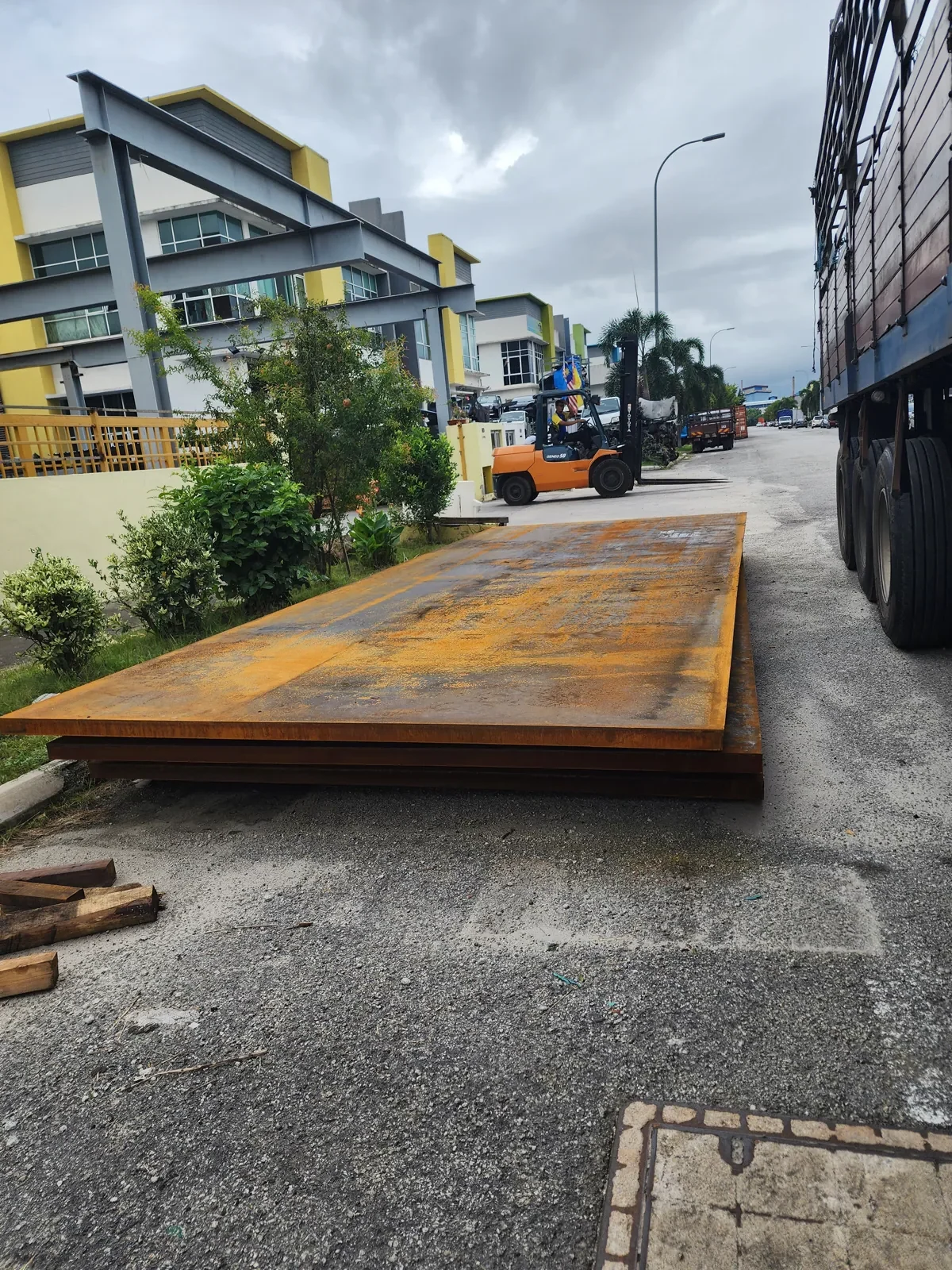
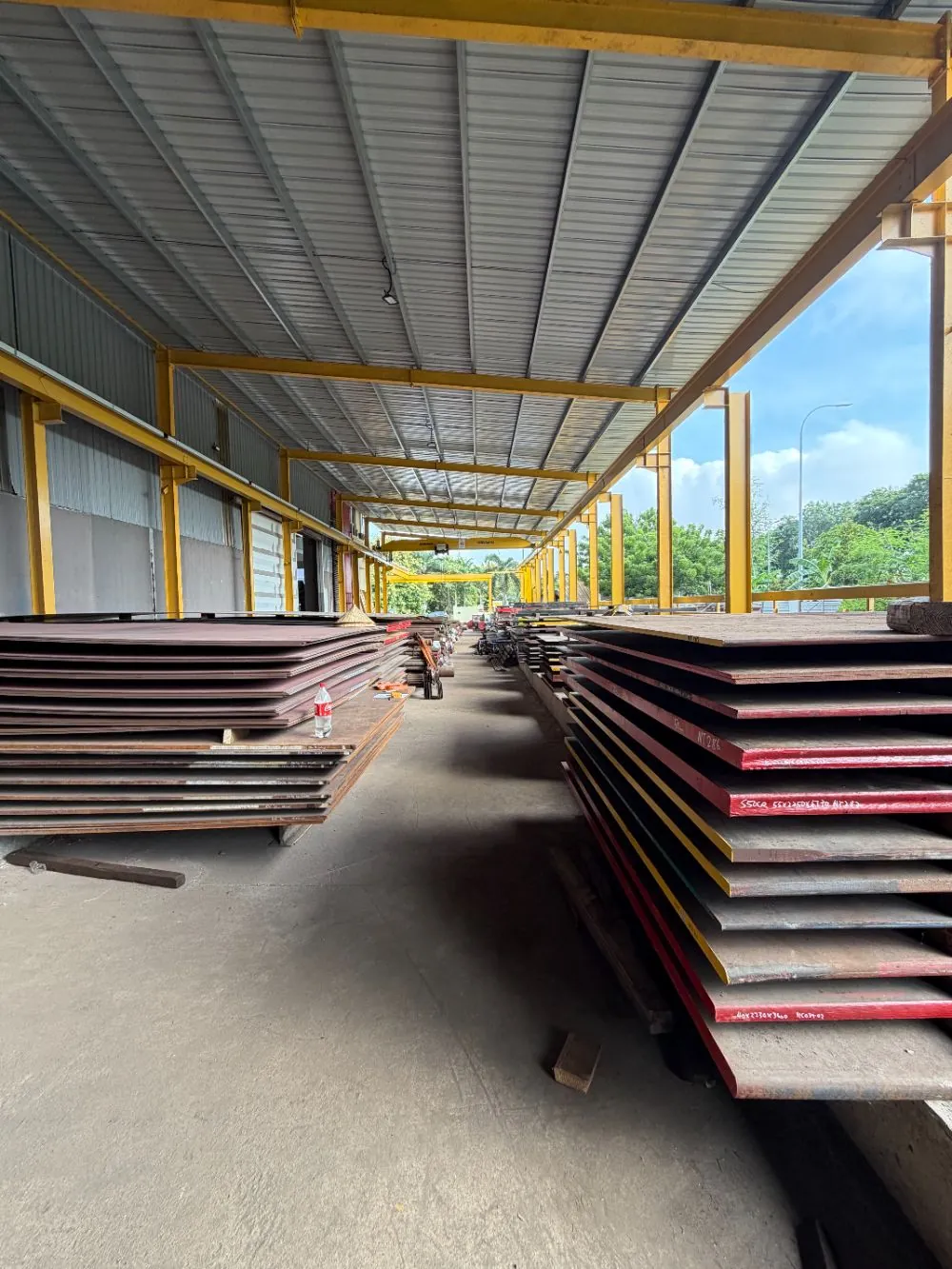
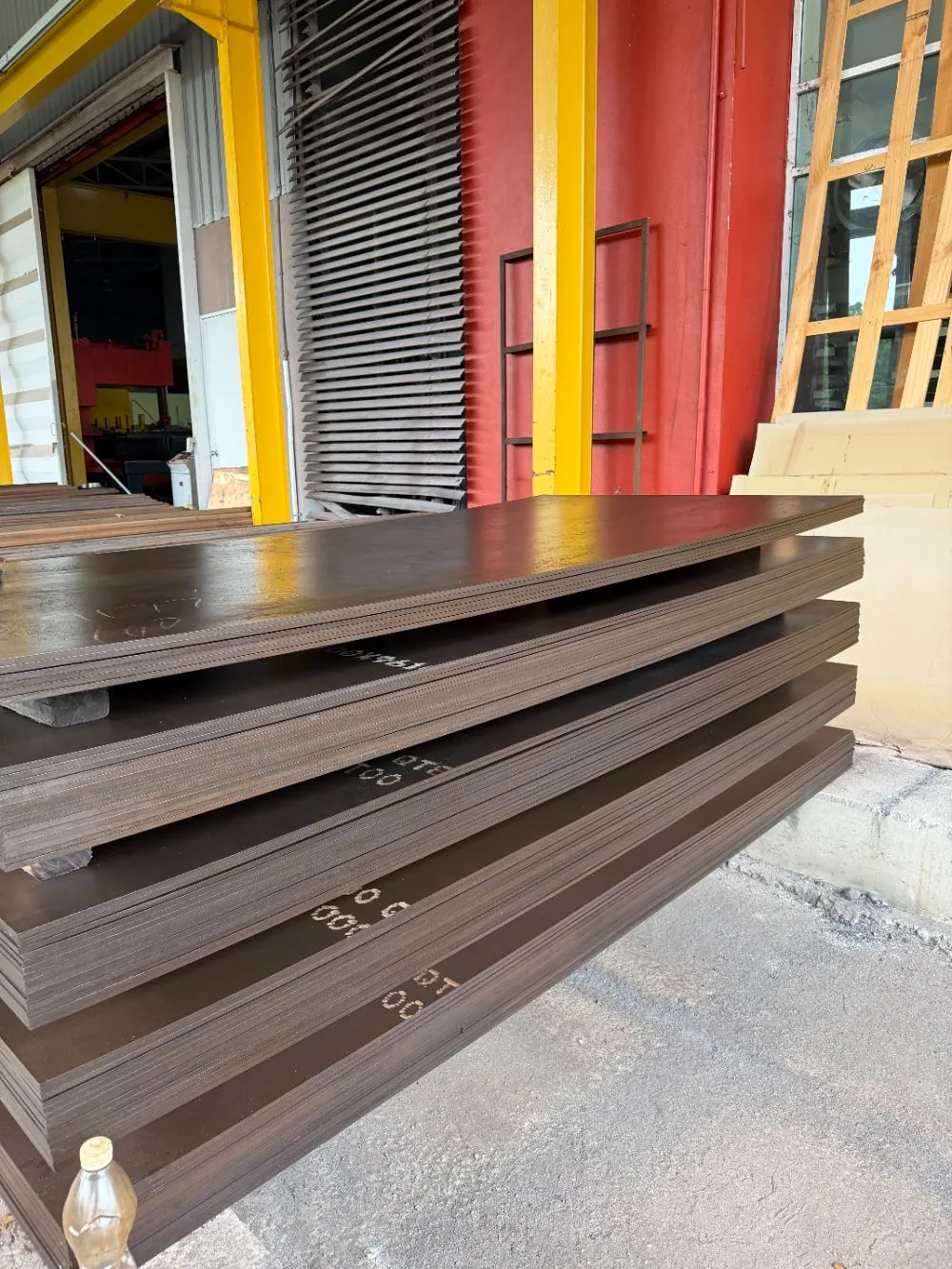
Structural, pressure vessel and wear-resistant steel plate: A36, S235JR, S275JR, S355JR, SS400, A283, A387, A516, A537 and AR / NM wear grades. Cut to size, no MOQ.
Structural steel plate is the base material for buildings, bridges, pressure vessels and heavy equipment. E STEEL SDN BHD supplies general structural grades, pressure vessel steels and abrasion-resistant wear plate, bandsaw-cut to size with no minimum order quantity.
ASTM A36, A283C, S235JR, SS400, SS41
ASTM A36 is a low carbon steel. Low carbon steels are classified by having less than 0.3% carbon by weight. This allows A36 steel to be easily machined, welded, and formed, making it extremely useful as a general-purpose steel. The low carbon also prevents heat treatment from having much of an effect on A36 steel. A36 steel usually has small amounts of other alloying elements as well, including manganese, sulfur, phosphorus, and silicon. These alloying elements are added to give A36 steel its desired chemical and mechanical properties. Since A36 does not contain large amounts of nickel or chromium, it does not have excellent corrosion resistance.
ASTM A36 steel plates will have a lot of equivalent materials, such as A283C, FE360B, E24-2, Chinese material Q235B, Japan material SS400 and SM400A, European material EN S235JR, Germany material DIN ST37-2, etc. Those equivalent materials have little difference in chemical composition and mechanical properties, below are some of the grades comparison for your reference:
ASTM A36 steel plate: ASTM A36 is a carbon structural steel standard formulated by the American Standards Association (ASTM), which has similar chemical composition and mechanical performance requirements as SS41 steel plate. ASTM A36 steel plates are commonly used in buildings, bridges, and general structural engineering.
S235JR steel plate: S235JR is a non-alloy structural steel specified in the European standard EN 10025-2, which is similar to SS41 steel plate in terms of chemical composition and mechanical properties. S235JR steel plate is widely used in construction, structure and machinery manufacturing fields.
ASTM A36 steel plates and A36 equivalent materials chemical composition: (%)
| Grade | C (t≤16mm) | Si | Mn | P | S | Cu | N |
|---|---|---|---|---|---|---|---|
| Q235B | 0.20 max | 0.35 max | 1.40 max | 0.045 max | 0.045 max | – | – |
| A36 | 0.26 max | 0.40 max | – | 0.040 max | 0.050 max | 0.20 min | – |
| A283C | 0.24 max | 0.04 max | 0.09 max | 0.035 max | 0.040 max | 0.20 min | – |
| S235JR | 0.19 max | – | 1.5 max | 0.045 max | 0.045 max | 0.60 max | 0.014 max |
| ST37-2 | 0.21 max | – | – | 0.065 max | 0.065 max | – | 0.010 max |
| SS400 | – | – | – | 0.050 max | 0.050 max | – | – |
ASTM A36 steel plates and A36 equivalent materials mechanical properties: (%)
| Grade | Yield strength ReH/(N/mm2) (t≤16mm) min | Tensile strength Rm/(N/mm2) (3mm≤t≤16mm) | Elongation A/% (3mm≤t≤40mm) min | Charpy V test | |
|---|---|---|---|---|---|
| Temperature/℃ | Impact energy (Longitudinal)/J min | ||||
| Q235B | 235 | 370-500 | 26 | +20 | 27 |
| A36 | 250 | 400-550 | 23 | – | – |
| A283C | 205 | 380-515 | 25 | – | – |
| S235JR | 235 | 360-510 | 26 | +20 | 27 |
| ST37-2 | 235 | 360-510 | 26 | +20 | 27 |
| SS400 | 245 | 400-500 |
A36 low carbon steel is used in many different industries for a variety of applications because of its relatively low cost. Also, as mentioned, the mechanical properties make it particularly suited for structural applications. Many bridges are constructed with A36 steel. Likewise, buildings are frequently created with A36 steel because of its high strength and toughness. A36 steel is also used for components in the automotive, construction, heavy equipment, and oil and gas industries.
The ASTM equivalents for JIS G3101 SS400 steel are ASTM A36 and ASTM A283C; the EN equivalent for JIS G3101 SS400 steel is S235JR. The DIN equivalent for JIS G3101 SS400 steel is ST37-2; and the GB equivalent for JIS G3101 SS400 steel is Q235B.
| Element | Percentage (%) |
|---|---|
| Carbon (C) | ≤0.24 |
| Manganese (Mn) | ≤0.90 |
| Phosphorus (P) | ≤0.035 |
| Sulfur (S) | ≤0.040 |
| Silicon (Si) | ≤0.40 |
| Property | Value |
|---|---|
| Tensile Strength | 310–415 MPa |
| Yield Strength | 165–310 MPa |
| Elongation (in 50mm) | 27–30% |
| Hardness (Brinell) | 110–140 HB |
| Property | A283 Grade C | A36 |
|---|---|---|
| Tensile Strength | 310–415 MPa | 400–550 MPa |
| Yield Strength | 165–310 MPa | 250 MPa (min) |
| Carbon Content | ≤0.24% | ≤0.26% |
| Primary Use | Low-pressure vessels | Structural framing |
ASTM A283 grade C and A36 steel aren’t exactly the same but very close. Based on the weldability, it can be considered that A36 steel can be used as an alternative substitution for ASTM A283 grade C. However, further Engineering approval is required if you decide on A36 steel as a substitution for ASTM A283 grade C.
The ASTM nearest equivalents for JIS G3101 SS400 steel are ASTM A36 and ASTM A283C; the EN equivalent for JIS G3101 SS400 steel is S235JR. The DIN equivalent for JIS G3101 SS400 steel is ST37-2; and the GB equivalent for JIS G3101 SS400 steel is Q235B.
S235JR | Q235B Structural Steel – Properties, Equivalents and Applications
Buy S235JR steel plates in Asia. E STEEL SDN BHD offers certified EN 10025-2 structural steel with fast ASEAN delivery & technical support.
Whether you’re building bridges, industrial plants, or offshore platforms, S235JR offers an excellent balance of strength, weldability, and cost efficiency.
S235JR is a non-alloy structural steel grade defined under the EN 10025-2 standard, widely used in structural and fabrication projects. The “S” denotes structural, “235” represents the minimum yield strength of 235 MPa, and “JR” indicates impact testing at room temperature (20°C).
Related Product: View All Structural Steel Grades
| Standard | Equivalent Grade |
|---|---|
| EN | S235JR |
| ASTM/ASME | ASTM A36 / A283 Grade C |
| JIS | SS400 |
| GB | Q235B |
| DIN | St37-2 |
Tip: If your project specifications list a different standard, our technical team can confirm the closest equivalent for compliance.
| Element | Max % |
|---|---|
| C | 0.17 |
| Mn | 1.40 |
| Si | 0.40 |
| P | 0.035 |
| S | 0.035 |
| N | 0.012 |
| Property | Value |
|---|---|
| Yield Strength (MPa) | ≥ 235 |
| Tensile Strength (MPa) | 360 – 510 |
| Elongation (%) | ≥ 26 |
| Impact Energy (J) | ≥ 27 @ 20°C |
Related Reading: ASTM A36 vs S235JR – Which is Best for Your Project?
S235JR is extensively used in:
Check Availability: S235JR Steel Plates
S275JR A structural grade (S) with at minimum yield strength of 275 N/mm²m, the JR designation confirms that the steel has undergone longitudinal Chary V-Notch impact testing at 27J (Joules) at room temperature. Other Charpy designations include JO and J2.
S symbol for structural steel JR symbol 20 temperature impact test. J0 symbol 0 temperature impact test
J2 symbol -20 temperature impact test
| Element | Percentage (%) |
|---|---|
| Carbon (C) | ≤0.22 |
| Manganese (Mn) | ≤1.50 |
| Phosphorus (P) | ≤0.035 |
| Sulfur (S) | ≤0.035 |
| Silicon (Si) | ≤0.55 |
| Property | Value |
|---|---|
| Yield Strength | 275 MPa (min) |
| Tensile Strength | 410–560 MPa |
| Elongation | 20–23% (in 50mm) |
| Impact Energy | 27 J at +20°C |
Comparison Q235 steel vs A36, SS400, S235JR and E250 steel, they are similar in chemical composition, mechanical properties, and all belong to carbon structural steels.
| Yield Strength (≥ N/mm2); Dia. (d) mm | Tensile Strength | |||||||
|---|---|---|---|---|---|---|---|---|
| Country | Steel Grade | d≤16 | 16 < d ≤40 | 40 < d ≤60 | 60 < d ≤100 | 100 < d ≤150 | 150 < d ≤200 | N/mm2 |
| China | Q235 | 235 | 225 | 215 | 215 | 195 | 185 | 370-500 |
| US | A36 | 250 MPa (d ≤ 200mm) | 400-550 | |||||
| European | S235 | 235 | 225 | 215 | 215 | 195 | 185 | 360-510 |
| Japan | SS400 | 245 | 235 | 215 | 215 | 205 | 205 | 400-510 |
| USA – | Germany DIN,WNr | Japan JIS | England BS | European old EN | Italy UNI | Spain UNE | China GB | Sweden SS | Austria ONORM | Russia GOST | International ISO | India IS |
|---|---|---|---|---|---|---|---|---|---|---|---|---|
| A529 | St 44-2 | SS400 | 43B | Fe430B | Fe430B | AE255B | Q275Z | 1412 | St430B | St4ps St4sp | E275B | IS2062 |
| Property | S275JR | S235JR |
|---|---|---|
| Yield Strength | 275 MPa | 235 MPa |
| Tensile Strength | 410–560 MPa | 360–510 MPa |
| Impact Energy | 27 J at +20°C | 27 J at +20°C |
| Typical Use | Medium-load structures | Light-load structures |
S355 Grade ranges S355JR, S355J0, S355J2, S355K2 which are non-alloy structural steel material specified in EN 10025 standard.
“S” means structural, “355” represent as yield strength at 355 Mpa minimum. JR specified the steel need to be impact testing at 27 Joules with longitudinal Charpy V-Notch impact test at room temperature. Which there are different designations of Charpy test includes J2, J0, and K2.
S355JR grade steel is an important material used in structural engineering. It gives excellent yield and tensile strength normally supplied with various treatments and test, to make sure it is a wise option to use in different industries and projects.
EN10025 European Standard Structural Steel
EN 10025 is the European standard structural steel for Hot rolled products in carbon steel. S355 grade is also defined in this standard, other than this grade there are also S235, S275, S460, S550, S620, S690 with conditions hot rolled, normalized, quenched, and tempered.
| Grade | symbol | |
|---|---|---|
| S355 | JR | Charpy impact tests at room temperature 20°C |
| J0 | Charpy impact tests at 0°C | |
| J2 | Charpy impact tests at -20°C | |
| S355J2 | N | Supply condition normalised |
| G3 | Supply condition normalised |
| Element | Percentage (%) |
|---|---|
| Carbon (C) | ≤0.24 |
| Manganese (Mn) | ≤1.60 |
| Phosphorus (P) | ≤0.035 |
| Sulfur (S) | ≤0.035 |
| Silicon (Si) | ≤0.55 |
| Property | Value |
|---|---|
| Yield Strength | ≥355 MPa |
| Tensile Strength | 470–630 MPa |
| Elongation | 20–22% (in 50mm) |
| Impact Energy | 27 J at 0°C |
| S355JR Steel Grade Equivalent Table | ||||||||
|---|---|---|---|---|---|---|---|---|
| USA | Japan | France | England | European | Italy | Belgium | Spain | China |
| JIS | AFNOR | BS | EN | UNI | NBN | UNE | GB | |
| A572 | SM490A | E36-2 | 50B | Fe510B | Fe510B | AE355B | AE355B | Q345C |
| SS490 |
| Property | S355JR | S275JR |
|---|---|---|
| Yield Strength | ≥355 MPa | ≥275 MPa |
| Tensile Strength | 470–630 MPa | 410–560 MPa |
| Impact Test Temp. | 0°C | +20°C |
| Typical Use | Heavy-load structures | Medium-load structures |
Malaysia’s Top Structural Steel Supplier: Cut-to-size SS400 & Equivalent Grades with No MOQ. Certified Plates for Construction, Bridges & Engineering. Get Instant Quotes!
We provide cut-to-size steel with no minimum order quantity (MOQ), helping engineering firms reduce wastage, save costs, and receive materials exactly to specification — whether for large infrastructure projects or small custom fabrications.
SS400 is a JIS G3101 standard structural steel with excellent weldability, formability, and strength, making it one of the most widely used steels in Asia’s structural applications. The “SS” stands for Steel Structure, while “400” refers to its minimum tensile strength of 400 MPa.
Explore More Structural Grades: View All Structural Steel Products
| Standard | Equivalent Grade |
|---|---|
| JIS | SS400 |
| EN | S235JR / S275JR |
| ASTM/ASME | ASTM A36 / A283 Grade C |
| GB | Q235B |
| DIN | St37-2 / St44 |
Tip: Our technical team can verify compliance if your project specifies a different steel standard.
| Element | Max % |
|---|---|
| Carbon (C) | 0.23 |
| Manganese (Mn) | 1.40 |
| Silicon (Si) | 0.35 |
| Phosphorus (P) | 0.035 |
| Sulfur (S) | 0.035 |
| Property | Value |
|---|---|
| Yield Strength (MPa) | ≥ 245 |
| Tensile Strength (MPa) | 400 – 510 |
| Elongation (%) | ≥ 17 |
| Impact Energy (J) | ≥ 27 @ 20°C |
Related Reading: ASTM A36 vs SS400 – Which is Better for Structural Projects?
SS400 and its equivalent grades are widely used for:
Check Stock: SS400 Plates – Cut to Size
SS41 structural steel plates/sheets: Equivalent Grade, Full composition table, mechanical properties & Asia applications. Request cut-to-size quote.
SS41 is a Japanese Industrial Standard (JIS) structural steel grade under JIS G3101, widely used in structural fabrication. It offers excellent weldability, good tensile strength, and is suitable for general structural applications.
The “SS” in SS41 means Steel Structure, and “41” refers to its minimum tensile strength of 41 kgf/mm² (approximately 400 MPa).
Related Product: View All Structural Steel Grades
| Standard | Equivalent Grade |
|---|---|
| JIS | SS41 |
| EN | S275JR / S235JR |
| ASTM/ASME | ASTM A36 / A283 Grade C |
| GB | Q235B |
| DIN | St37-2 / St44 |
Tip: If your specifications list a different standard, our technical team can confirm the closest equivalent to match your project requirements.
| Element | Max % |
|---|---|
| C | 0.23 |
| Mn | 1.40 |
| Si | 0.35 |
| P | 0.035 |
| S | 0.035 |
| Property | Value |
|---|---|
| Yield Strength (MPa) | ≥ 245 |
| Tensile Strength (MPa) | 400 – 510 |
| Elongation (%) | ≥ 17 |
| Impact Energy (J) | ≥ 27 @ 20°C |
Related Reading: ASTM A36 vs SS41 – Which Should You Choose?
SS41 is widely used in:
Check Availability: SS41 Steel Plates
| Element | Percentage (%) |
|---|---|
| Carbon (C) | ≤0.15 |
| Chromium (Cr) | 0.80–1.20 |
| Molybdenum (Mo) | 0.45–0.60 |
| Manganese (Mn) | 0.40–0.65 |
| Phosphorus (P) | ≤0.025 |
| Sulfur (S) | ≤0.025 |
| Silicon (Si) | 0.50–0.80 |
| Property | Value |
|---|---|
| Tensile Strength | 415–585 MPa |
| Yield Strength | ≥220 MPa |
| Elongation | 22% (in 50mm) |
| Hardness (Brinell) | 121–163 HB |
| Standard | Equivalent Grade |
|---|---|
| EN | 13CrMo4-5 (1.7335) |
| JIS | SCMV 1 |
| GB | 15CrMo |
| DIN | 13CrMo4-4 |
ASTM A387 Grade 12 is ideal for:
| Property | A387 Gr 12 | A516 Gr 70 |
|---|---|---|
| Max Temperature | 540°C | 370°C |
| Corrosion Resistance | Moderate (Cr-Mo alloy) | Limited (carbon steel) |
| Key Use | High-temperature pressure vessels | Low-temperature storage tanks |
We supply high quality ASME SA387 Gr12 Class 2 and ASTM A387 Gr22 Class 2 chrome moly pressure vessel steel plates from various origin such as Korea, Japan, China, Belgium & Germany. A387-12-2 and SA387-22-2 are described as “Standard Specification for Pressure Vessel Plates, Chromium-Molybdenum Carbon Alloy Steel “.
| Property | Grade 12 (1Cr-0.5Mo) | Grade 22 (2.25Cr-1Mo) |
|---|---|---|
| Chromium (Cr) | 0.80–1.20% | 2.00–2.50% |
| Molybdenum (Mo) | 0.45–0.60% | 0.90–1.10% |
| Max Temperature | 540°C (1,000°F) | 580°C (1,075°F) |
| Tensile Strength | 415–585 MPa | 515–690 MPa |
| Key Applications | Boilers, heat exchangers | Reactors, hydrocrackers |
| Element (%) | Grade 12 | Grade 22 |
|---|---|---|
| Carbon (C) | ≤0.15 | ≤0.15 |
| Manganese (Mn) | 0.40–0.65 | 0.30–0.60 |
| Phosphorus (P) | ≤0.025 | ≤0.025 |
| Sulfur (S) | ≤0.025 | ≤0.025 |
| Silicon (Si) | 0.50–0.80 | 0.50–0.80 |
| Property | Grade 12 | Grade 22 |
|---|---|---|
| Tensile Strength | 415–585 MPa | 515–690 MPa |
| Yield Strength | 220 MPa (min) | 310 MPa (min) |
| Elongation | 22% (in 50mm) | 20% (in 50mm) |
| Hardness (Brinell) | 121–163 HB | 149–192 HB |
| Standard | Grade 12 | Grade 22 |
|---|---|---|
| EN | 13CrMo4-5 | 10CrMo9-10 |
| JIS | SCMV 1 | SCMV 4 |
| GB | 15CrMo | 12Cr2Mo1 |
| DIN | 13CrMo4-4 | 10CrMo9-10 |
SA516 SA516 Gr.70 steel is a carbon pressure vessel steel grade for moderate and lower temperature service. SA516 is the most popular Pressure Vessel grade of steel plate in the industry. It is produced in grades 55, 60, 65 & 70. The most common is Grade 70
ASTM A516 Grade 70 steel is one of the most popular steels for boilers, pressure vessels and heat exchangers. It is excellent at low temperature and have good results on standard Charpy V Notch toughness tests. A516 70 is according to the ASTM standard A516/A516M
| Element | Percentage (%) |
|---|---|
| Carbon (C) | ≤0.27 |
| Manganese (Mn) | 0.85–1.20 |
| Phosphorus (P) | ≤0.035 |
| Sulfur (S) | ≤0.035 |
| Silicon (Si) | 0.15–0.40 |
| Property | Value |
|---|---|
| Tensile Strength | 485–620 MPa |
| Yield Strength | ≥260 MPa |
| Elongation | 21% (in 50mm) |
| Impact Energy | 20 J at -45°C |
Engineers choose ASTM A516 Grade 60 instead of Grade 70 when the design requirements do not need the higher strength of Grade 70, and when other factors such as cost, weldability, toughness, or fabrication are more important.
| Property | A516 Gr 60 | A516 Gr 70 |
|---|---|---|
| Tensile Strength | 415–550 MPa | 485–620 MPa |
| Yield Strength | ≥220 MPa | ≥260 MPa |
| Low-Temperature Use | -30°C | -45°C |
| Typical Applications | Moderate pressure | High-pressure, cryogenic |
Grade 60 is generally less expensive than Grade 70. If the required thickness already satisfies the design code, using Grade 70 provides no economic benefit.
Example: A low-pressure storage vessel may already meet ASME requirements with Grade 60, so paying more for Grade 70 is unnecessary.
Grade 60 is softer and more ductile, making it easier to:
This is important for complex vessel geometries.
Many vessels are governed by:
rather than tensile strength. In such cases, Grade 70’s higher strength does not reduce thickness significantly.
For some low-temperature applications, Grade 60 may provide acceptable impact properties more easily, depending on the plate mill and heat treatment. Engineers often evaluate actual Charpy test results rather than strength alone.
Some companies have standardized on Grade 60 because:
Using a standard material simplifies procurement and fabrication.
Engineers often select Grade 70 when:
For ASME Section VIII pressure vessels, Grade 70 typically has a higher allowable stress, allowing thinner plates and lower vessel weight.
Suppose a vessel requires a calculated thickness of:
If the specification already requires a minimum 20 mm plate for corrosion allowance, fabrication, or handling reasons, both grades end up using 20 mm plate. In that case, Grade 60 is usually chosen because it is cheaper and easier to fabricate.
Engineers choose A516 Grade 60 over Grade 70 when:
For pressure vessel design, the decision is usually based on a detailed comparison of required thickness, fabrication cost, material cost, and code allowable stress, not simply on which grade has higher strength.
ASTM A537 Class 2 (also standardized as ASME SA537 Class 2) is a high-strength, heat-treated carbon-manganese-silicon steel plate specifically designed for pressure vessel and boiler applications requiring enhanced strength and impact toughness.
The material undergoes a quenching and tempering heat treatment process, providing significantly higher yield and tensile strength compared to normalized carbon steel grades. Its excellent toughness at lower temperatures makes it particularly suitable for demanding service conditions in the oil & gas, petrochemical, power generation, and cryogenic storage industries.
ASTM A537 Class 2 is a pressure vessel quality steel plate specification covering heat-treated carbon-manganese-silicon steel plates intended for fusion-welded pressure vessels and boilers.
Compared to ASTM A516 grades, A537 Class 2 offers:
The ASME equivalent designation is SA537 Class 2, commonly specified for pressure-retaining equipment constructed according to ASME Boiler and Pressure Vessel Code requirements.
| Element | Composition (%) |
|---|---|
| Carbon (C) | ≤ 0.24 |
| Manganese (Mn) | 1.00 – 1.60 |
| Silicon (Si) | 0.15 – 0.50 |
| Phosphorus (P) | ≤ 0.035 |
| Sulfur (S) | ≤ 0.035 |
Actual chemical composition may vary depending on plate thickness and mill production requirements.
| Property | Value |
|---|---|
| Yield Strength | Minimum 415 MPa (60 ksi) |
| Tensile Strength | 550 – 690 MPa (80 – 100 ksi) |
| Elongation (200 mm) | Minimum 18% |
| Heat Treatment | Quenched and Tempered |
These mechanical properties make ASTM A537 Class 2 an excellent choice for pressure-containing equipment subjected to high operating pressures and demanding service conditions.
Quenched and tempered processing provides superior yield and tensile strength compared to conventional pressure vessel steels.
Offers outstanding impact resistance and toughness, particularly in low-temperature and cryogenic applications.
Designed specifically for pressure-retaining equipment requiring reliable performance under high stress conditions.
Can be welded using standard industrial welding procedures when proper preheating and post-weld practices are followed.
Suitable for storage tanks and pressure vessels operating in cold climates or handling refrigerated products.
ASTM A537 Class 2 steel plates are widely used in critical industrial applications, including:
| Property | ASTM A537 Class 2 | ASTM A516 Grade 70 |
|---|---|---|
| Heat Treatment | Quenched & Tempered | Normalized/As Rolled |
| Yield Strength | Higher | Moderate |
| Tensile Strength | Higher | Lower |
| Toughness | Excellent | Good |
| Pressure Applications | Severe Service | General Service |
| Cryogenic Service | Preferred | Limited |
For applications requiring greater strength and toughness, ASTM A537 Class 2 is often selected over ASTM A516 Grade 70.
Availability may vary depending on mill production schedules and project requirements.
AR 400, JFE 400, NM 400
We offer Wear Resistance AR 400 Steel Plate. ABREX 400, also called SUMIHARD 400, is a union of toughness and hardness, giving it the exclusivity to be used in moderate wear areas. They are designed to weld quickly, looking good in appearance. Our ABREX 400 wear plates have a uniform thickness that guarantees an excellent surface finish.
The Abrex 400 and 500 series (Previously named as Sumihard 400 and 500) is the wear plate series form Nippon Sumitomo Steel Metal Corporation, Japan.
The use of abrasion resistance ABREX steel plate markedly reduces the weight of structural members exposed to serve abrasive conditions. Compare with regular steel, ABREX steel plate reduces structural weight and delivers economic merits.
Adoption of high performance abrasion resistant ABREX will prolong the service life of machinery and component.
Abrex / Sumihard 400 is a through hardened abrasion resistant steel with a typical hardness of 415 BHN. These steels are the most widely used of the wear resistant grades. They exhibit an excellent combination of high resistance to impact, workability, weld ability and resistance to abrasion. It has about 3 times the abrasion resistance of common steel plate and contributes to prolonging the service life of mechanical parts.
WEAR RESISTANT STEEL PATES is used in areas where there is likely to be a high degree of abrasion or wear of the steel plate.
Steels with a high HB rating (Brinel Hardness) are intended for applications where wear or abrasion resistance is important. The benefit of using an abrasion resistant steel is that that the plant, machinery or constructions working life can be extended considerably. This can significantly improve the reliability, durability and safety of structures and equipment. It also helps to reduce the maintenance costs associated with wear and breakdown of plant.
400 HB steel is over 3 times harder than mild steel (120HB), but only a third as hard as stainless steel (1250HB)
Abrasion-resistant steel plates for Cement Plants & Refractory Product Plants: hoppers, crushers, chutes, cyclones, excavator buckets
The major difference is impact resistance. AR500 has higher abrasion resistance, but AR400 has higher impact resistance. … AR500 steel can withstand the abrasion that the rocks cause by sliding better than the AR400 steel, meaning it would last longer.
he technical difference between AR400, AR450 and AR500 is the Brinell Hardness Number (BHN), which indicates the material’s level of hardness:
AR400: 360-440 BHN Typically AR450: 430-480 BHN Typically AR500: 460-544 BHN Typically
Projects that require AR materials are typically those that need a specific balance between hardness and brittleness. As you increase hardness, you also increase brittleness, making the material difficult to form, shape and weld. For some projects, hardness is critical, so brittleness is sacrificed. But in other cases, the material must be formed and handled, so the level of hardness must be reduced.
AR500, Wear Plate 500, NM 500
I was wondering if you had a problem sourcing AR400, JFE EH400 Japan Origin?
Reason I ask is, our company have AR400 JFE EH400 Japan Origin ready stock.
I would love the opportunity to provide AR400 JFE EH400 Japan Origin for you.
Interested to find out more?
Abrasion-resistant (AR) steel plate is a high-carbon alloy steel plate, which signifies that AR is formable and weather-resistant due to the added alloys, and harder due to the addition of carbon.
JFE-EH-C500 Plate is suitable for heavy pieces of machinery such as tonnage ships and excavating cranes because of its heavy thickness.JFE Everhard 500 Wear Resistant Plate can stand harsh industrial environment, such as low temperatures up to – 40°C. These advanced JFE 500 plates withstand high impact forces. JEF-EH-C500 Plates have welded joints safety increasing crack resistance.
JFE Everhard 500 Plate Chemical Composition
| Chemical Properties of JFE-EH500 (%) | |||||||||||
|---|---|---|---|---|---|---|---|---|---|---|---|
| Heat treatment | C | Si | Mn | P | S | Cr | Ti | Mo | B | Ceq** | |
| Controlled heat treatment | max % | max % | max % | max % | max % | max % | max % | max % | max % | typv | |
| 0.29 | 0.55 | 1.60 | 0.020 | 0.01 | 0.80 | 0.020 | 0.35 |
JFE EH 500 Plate Mechanical Properties
| Mechanical properties of EVERHARD-C500LE | ||||||
|---|---|---|---|---|---|---|
| Brand name | Mechanical Property | Charpy Impact Test | Hardness test | |||
| EVERHARD-C500LE | Yield strength | Tensile strengt | Elongation % | Testing direction | Absorbed energy vE Average J | Brinell hardness (29.42kN) Average of 5 points |
| N/mm2 | N/mm2 | Min % | L | −40°C 42 | 502 | |
| 1203 | 1681 | 17 |
I was wondering if you had a problem sourcing AR400 JFE EH400 Japan Origin?
Reason I ask is, our company have AR400 JFE EH400 Japan Origin ready stock.
would love the opportunity to provide AR400 JFE EH400 Japan Origin for you.
Refer to the link for more info : https://www.ecarbonsteel.com/index.php?ws=showproducts&products_id=3174077&cat=Structure-Steel#openproducts
NM400, NM450, NM500 Wear Resistant Steel Plate
We offer Wear Resistance Steel Plate Nm400, Nm450,Nm500 from Chinese main factory XINGCHENG SPECIAL STEEL with prime quality, and the plate is widely used in mining machinery, cement industries, quarry, construction machinery, environmental protection machinery, metallurgical machinery, loader, blade plate, side blade plate.
Wear resistant steel plate NM400, NM450, NM500 etc. is from Chinese main factory XINGCHENG SPECIAL STEEL with prime quality, and the plate is widely used in mining machinery, cement industries, quarry, construction machinery, environmental protection machinery, metallurgical machinery, loader, blade plate, side blade plate.
| Grade | C | Si | Mn | P | S | Cr | Mo | Ni | Bt |
|---|---|---|---|---|---|---|---|---|---|
| NM360 | ≤0.25 | ≤0.70 | ≤1.60 | ≤0.025 | ≤0.015 | ≤0.80 | ≤0.50 | ≤0.50 | 0.0005-0.006 |
| NM400 | ≤0.30 | ≤0.70 | ≤1.60 | ≤0.025 | ≤0.010 | ≤1.00 | ≤0.50 | ≤0.70 | 0.0005-0.006 |
| NM450 | ≤0.35 | ≤0.70 | ≤1.70 | ≤0.025 | ≤0.010 | ≤1.10 | ≤0.55 | ≤0.80 | 0.0005-0.006 |
| NM500 | ≤0.38 | ≤0.70 | ≤1.70 | ≤0.020 | ≤0.010 | ≤1.20 | ≤0.65 | ≤1.00 | 0.0005-0.006 |
| NM550 | ≤0.38 | ≤0.70 | ≤1.70 | ≤0.020 | ≤0.010 | ≤1.20 | ≤0.70 | ≤1.00 | 0.0005-0.006 |
| NM600 | ≤0.45 | ≤0.70 | ≤1.90 | ≤0.020 | ≤0.010 | ≤1.50 | ≤0.80 | ≤1.00 | 0.0005-0.006 |
| Grade | Tensile Strength | Elongation | Impact test(-20°) | HBW |
|---|---|---|---|---|
| NM360 | ≥1100 | ≥12 | ≥24 | 330-390 |
| NM400 | ≥1200 | ≥10 | ≥24 | 370-430 |
| NM450 | ≥1250 | ≥7 | ≥24 | 420-480 |
| NM500 | / | / | / | ≥470 |
| NM550 | / | / | / | ≥530 |
| NM600 | / | / | / | ≥570 |
The technical difference between AR400, AR450 and AR500 is the Brinell Hardness Number (BHN), which indicates the material’s level of hardness:
AR400: 360-440 BHN Typically AR450: 430-480 BHN Typically AR500: 460-544 BHN Typically
Projects that require AR materials are typically those that need a specific balance between hardness and brittleness. As you increase hardness, you also increase brittleness, making the material difficult to form, shape and weld. For some projects, hardness is critical, so brittleness is sacrificed. But in other cases, the material must be formed and handled, so the level of hardness must be reduced.
EH 450, AR450, AR500, NM 450 Abrasion-Resistant Steel Plate
| Element | Percentage (%) |
|---|---|
| Carbon (C) | ≤0.30 |
| Manganese (Mn) | ≤1.60 |
| Silicon (Si) | ≤0.70 |
| Chromium (Cr) | ≤1.50 |
| Boron (B) | ≤0.005 |
| Phosphorus (P) | ≤0.025 |
| Sulfur (S) | ≤0.010 |
| Property | Value |
|---|---|
| Hardness (Brinell) | 430–480 HBW |
| Tensile Strength | 1,400–1,800 MPa |
| Yield Strength | ≥1,000 MPa |
| Impact Toughness | ≥24 J (-20°C) |
| Standard | Equivalent Grade |
|---|---|
| ISO | AR450 |
| SSAB | Hardox 450 |
| JFE | JFE EH450 |
| DIN | XAR 450 |
NM450 is ideal for industries requiring robust wear resistance:
| Property | NM450 | NM400 | NM500 |
|---|---|---|---|
| Hardness (HBW) | 430–480 | 370–430 | 480–530 |
| Tensile Strength | 1,400–1,800 MPa | 1,200–1,600 MPa | 1,600–2,000 MPa |
| Typical Use | Moderate-to-severe abrasion | Light-to-moderate abrasion | Extreme abrasion |
Bandsaw technology ensures minimal kerf loss and clean, burr-free edges.
Cut to the size your job needs. No minimum order quantity.
Mill test reports (MTRs) for traceability.
Fast air and sea shipping with real-time tracking.
Yes! It’s highly weldable using SMAW, GMAW, or FCAW methods.
Absolutely! We cater to prototypes and small batches with no MOQ.
Air freight delivery in 5–7 business days; sea freight varies by location.
Yes! It has excellent weldability with common methods (SMAW, GMAW).
Construction, shipbuilding, and general fabrication for non-critical applications.
Yes! We partner with logistics providers for air, sea, and land freight.
No—it’s typically used in the as-rolled condition.
Yes! It offers excellent weldability with methods like SMAW, GMAW, and FCAW.
Hot-rolled, shot-blasted, or primed (upon request).
Absolutely. We partner with trusted logistics providers for global delivery.
No—it’s typically used in the as-rolled condition.
Yes! It offers excellent weldability using methods like SMAW, GMAW, and SAW.
No—it is typically used in the as-rolled condition.
Yes, but preheating (150–200°C) and post-weld heat treatment (PWHT) are recommended to prevent cracking.
Grade 22 (higher Cr-Mo content) resists hydrogen embrittlement better.
Yes, but use preheating (Grade 12: 150°C; Grade 22: 200°C) and post-weld heat treatment (PWHT).
Grade 22 costs 15–20% more due to higher alloy content.
Yes! Use preheating (150–200°C) for thick sections and low-hydrogen electrodes (E7018).
Yes! All orders include ASTM-compliant MTRs (Mill Test Reports).
Absolutely—we coordinate with logistics partners for global delivery.
Yes, but use low-hydrogen electrodes and preheating (100–150°C) to avoid cracking.
Absolutely! Laser cutting ensures precision for ready-to-install components.
No MOQ, shipped globally from Malaysia. Send us the size and we will cut it.