
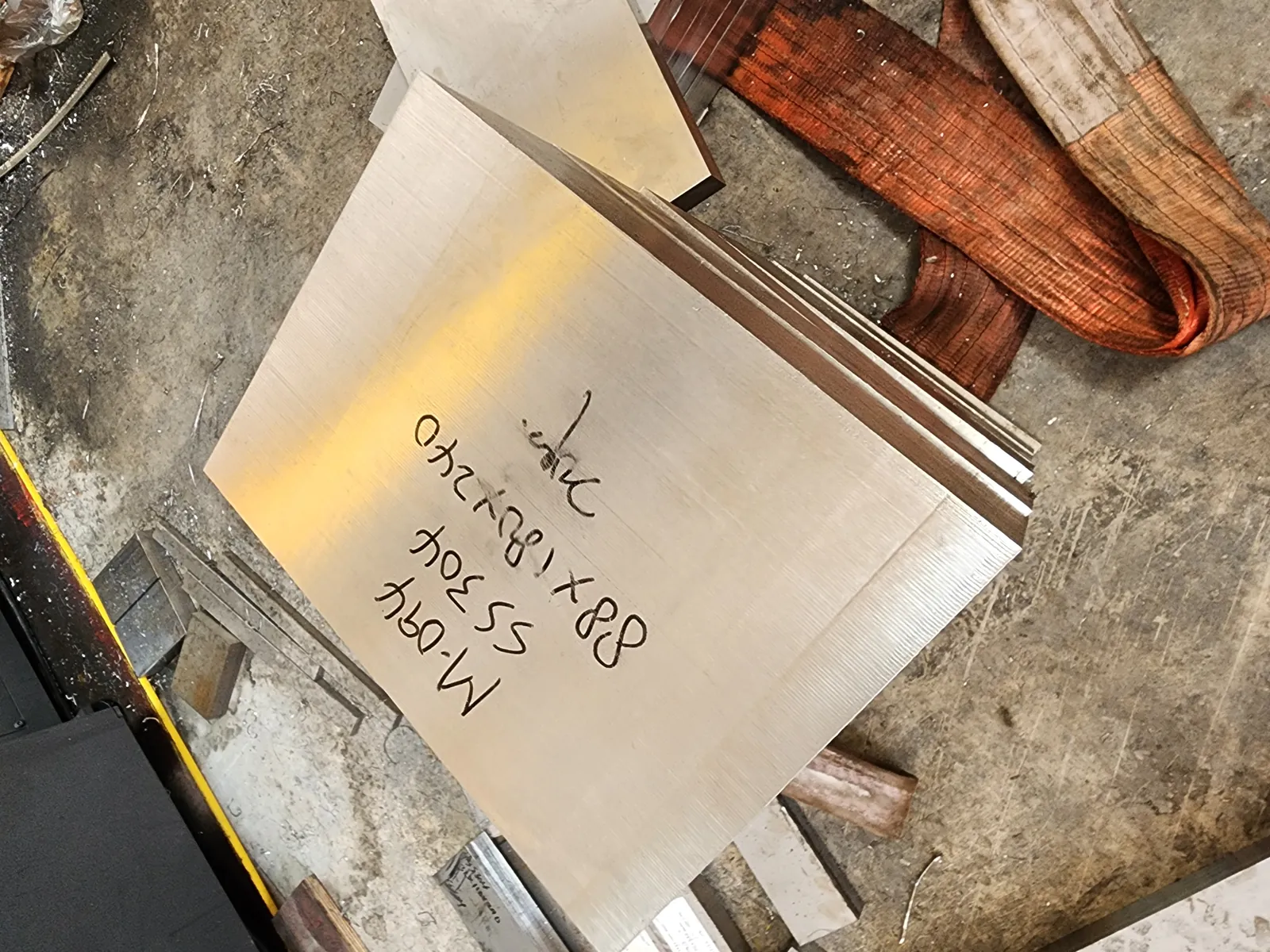
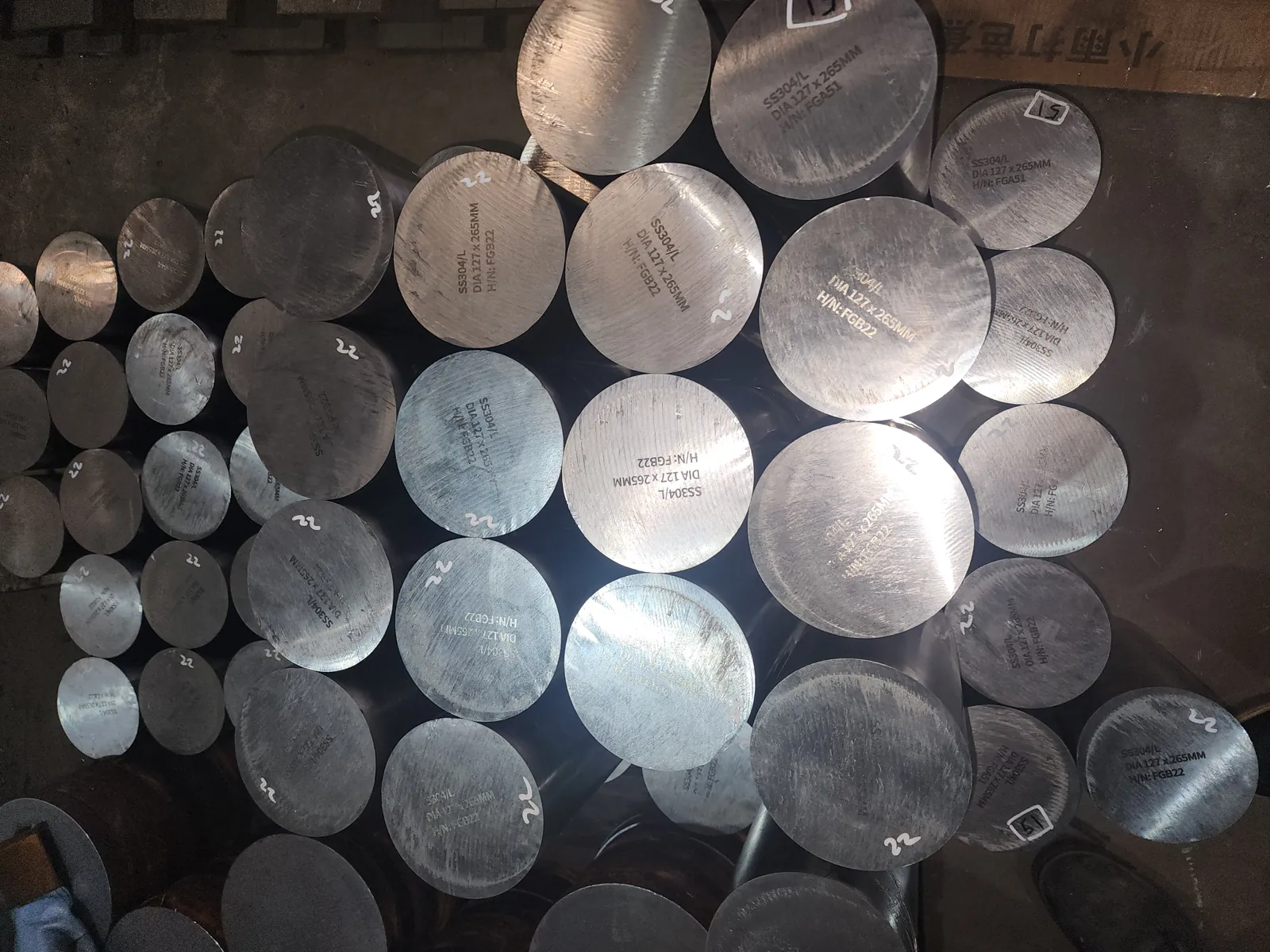
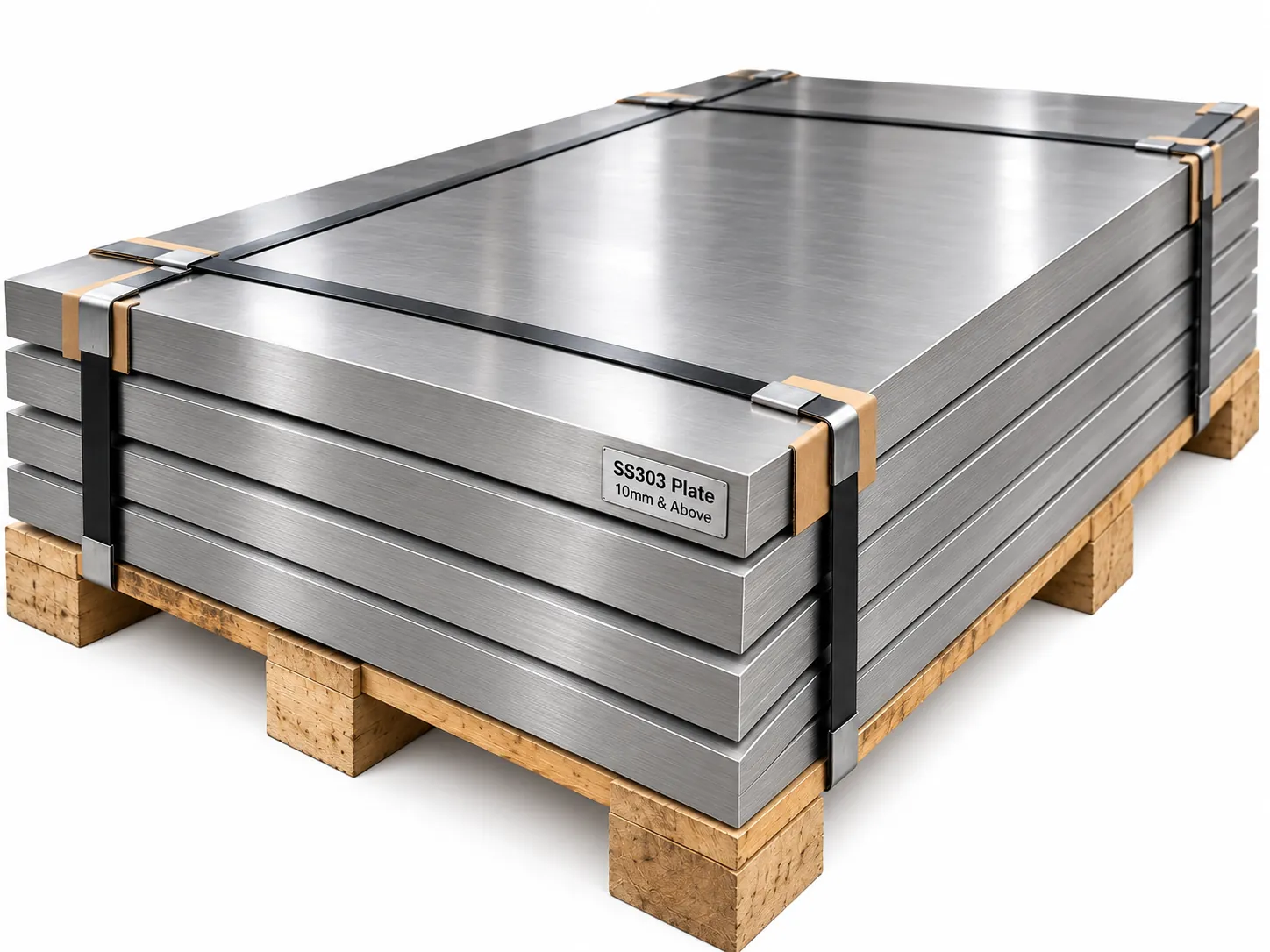
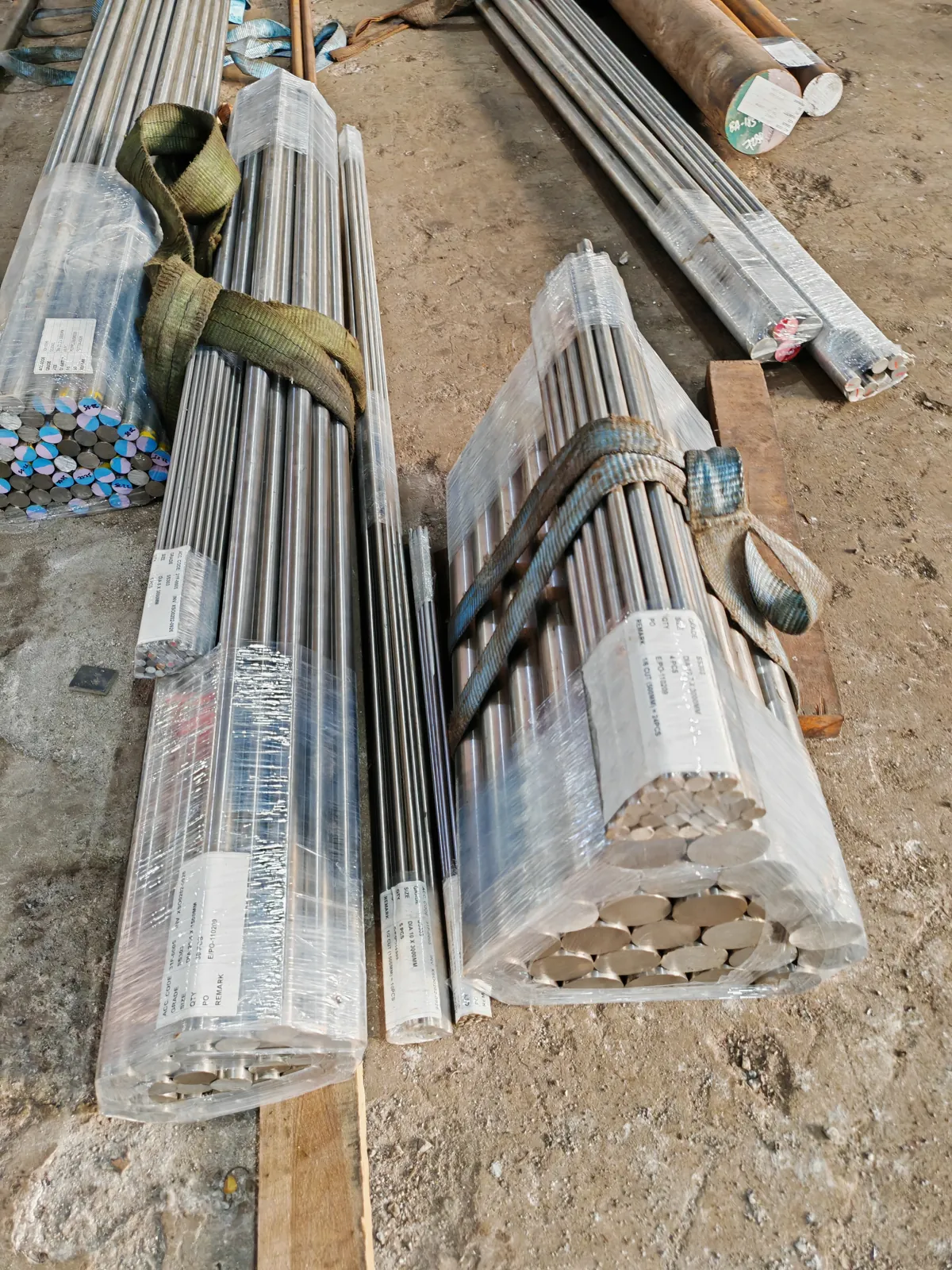
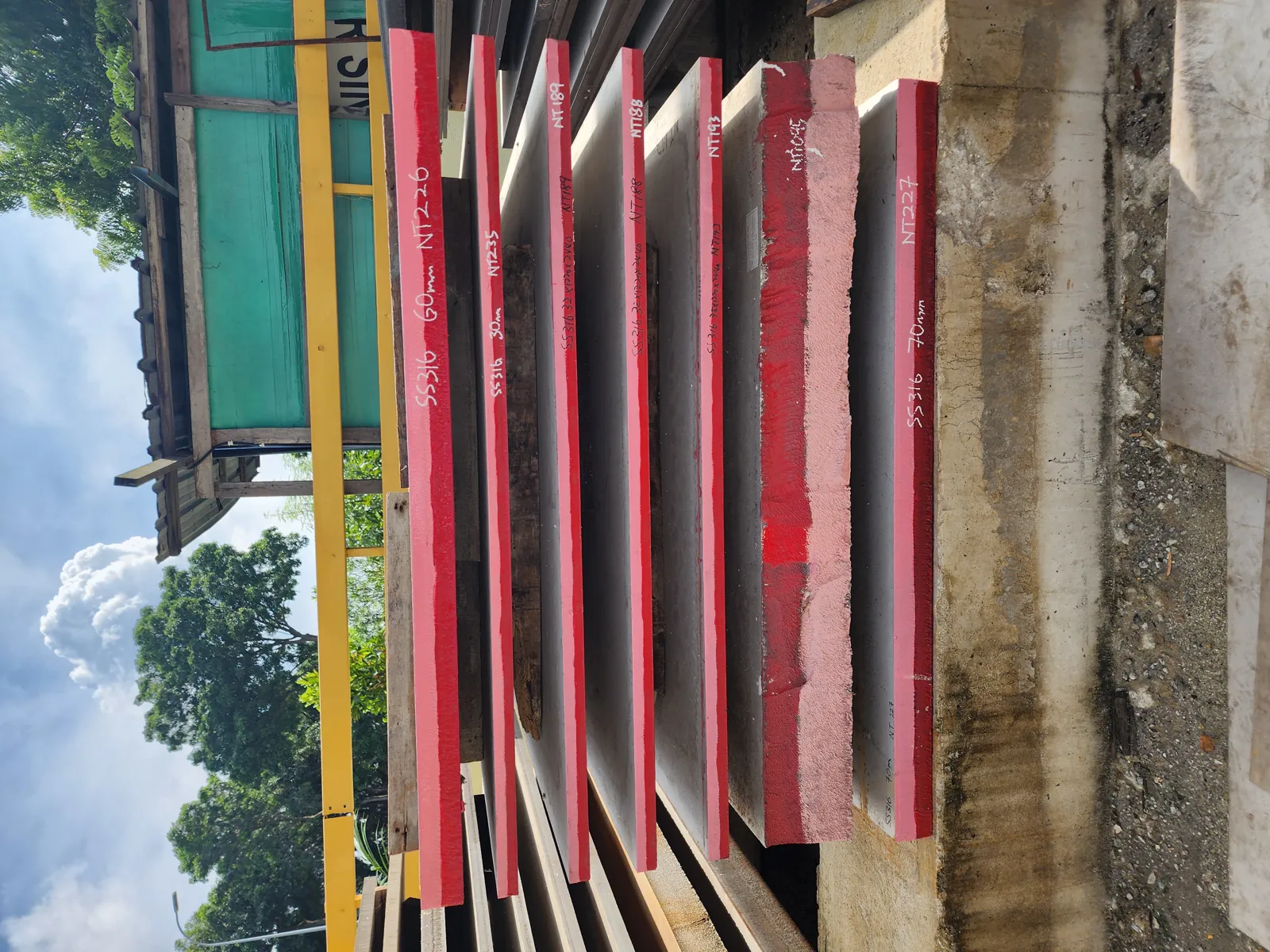
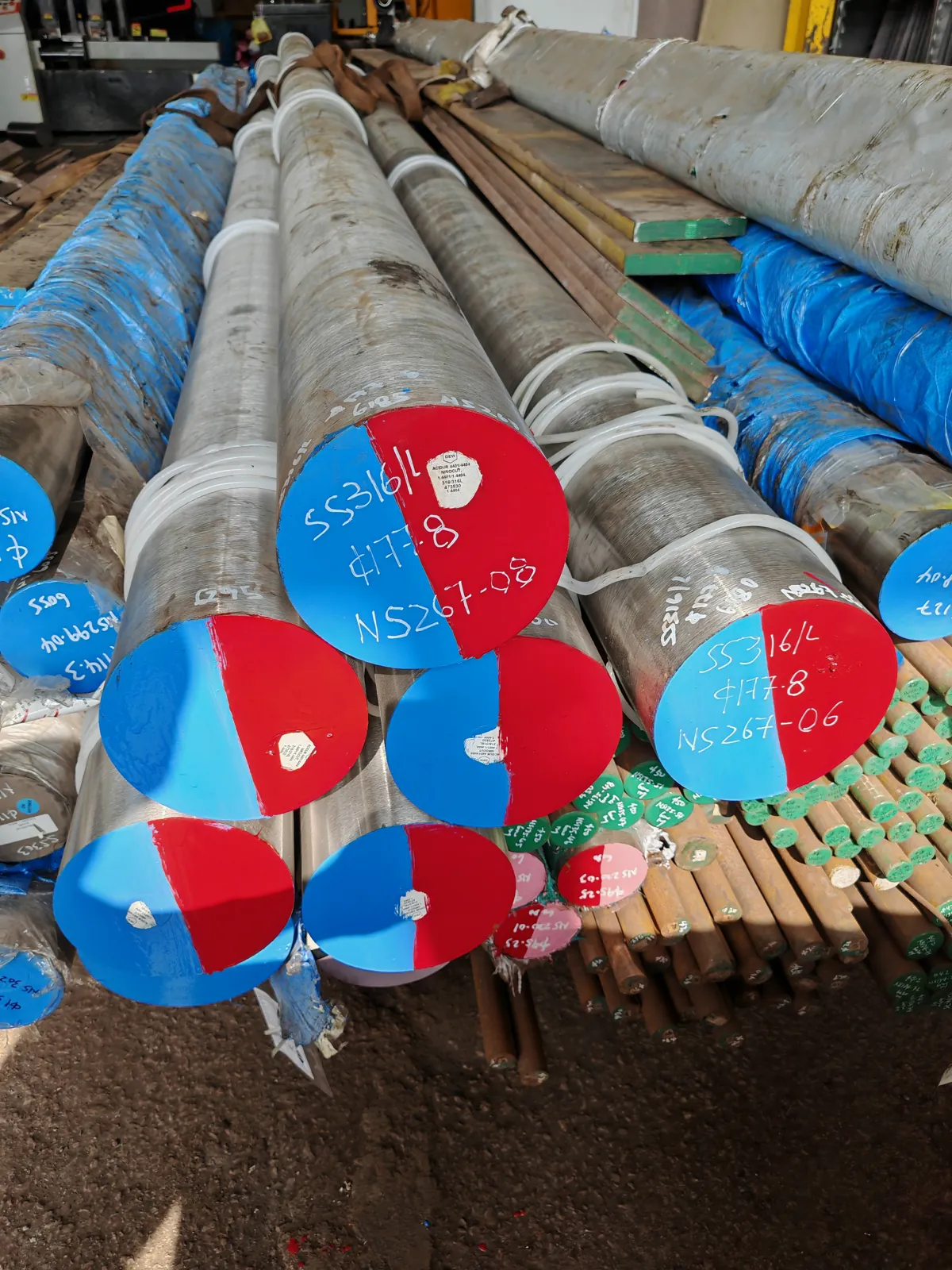
Austenitic stainless steel grades 303, 304 and 316 in bar, plate and sheet. Free-machining 303, general-purpose 304 and molybdenum-bearing 316, including L and dual-certified grades. No MOQ, cut to size.
Austenitic stainless steels are the most widely used stainless family, valued for corrosion resistance, formability and weldability. E STEEL SDN BHD holds the 300 series in bar, plate and sheet, cut to your size with no minimum order quantity.
This page covers three families: free-machining 303 and 303Cu, general-purpose 304 and 304L, and molybdenum-bearing 316 and 316L, including dual-certified material.
Stainless Steel 303 vs. 303Cu
Global Supplier of SS303 & SS303Cu Stainless Steel E STEEL SDN BHD – Precision Bandsaw-Cut Bars, Sheets, and Plates. ±0.2mm Tolerances. Fast Global Delivery, Zero MOQ.
SS303 and SS303Cu are free-machining austenitic stainless steels optimized for high-speed CNC operations. While SS303 uses sulfur for machinability, SS303Cu adds copper to enhance performance in specific applications. This guide helps engineers and procurement teams select the right grade for their needs.
| Element | SS303 (ASTM A582) | SS303Cu (Proprietary Grade) |
|---|---|---|
| Chromium (Cr) | 17–19% | 17–19% |
| Nickel (Ni) | 8–10% | 8–10% |
| Sulfur (S) | 0.15–0.35% | 0.15–0.35% |
| Copper (Cu) | ≤0.60% | 1.5–2.5% (key difference) |
| Manganese (Mn) | ≤2.0% | ≤2.0% |
Key Insight: SS303Cu’s copper addition improves machinability in high-speed operations and reduces tool wear.
| Property | SS303 (Annealed) | SS303Cu (Annealed) |
|---|---|---|
| Tensile Strength | 550–750 MPa | 520–700 MPa |
| Yield Strength | 240–310 MPa | 220–290 MPa |
| Elongation (%) | 35–50 | 35–50 |
| Hardness (HB) | 150–220 | 140–200 |
| Machinability | Excellent (due to sulfur) | Superior (Cu reduces friction) |
| Grade | UNS | EN (EU) | JIS (Japan) | GB (China) |
|---|---|---|---|---|
| SS303 | S30300 | 1.4305 (X8CrNiS18-9) | SUS 303 | Y1Cr18Ni9 |
| SS303Cu | – | – | – | Custom* |
SS303Cu is a proprietary variant; consult E STEEL SDN BHD for equivalents.
| SS303 | SS303Cu |
|---|---|
| – Automotive fasteners | – High-speed CNC components |
| – Industrial fittings | – Complex threaded parts |
| – Valve stems | – Aerospace bushings |
| – Decorative hardware | – Medical device machining |
| Factor | SS303 | SS303Cu |
|---|---|---|
| Machinability | High (sulfur) | Higher (copper reduces tool wear) |
| Corrosion Resistance | Moderate (avoid chlorides) | Slightly lower due to Cu |
| Cost | Standard | Slightly higher |
| Best For | General machining | Precision, high-speed CNC |
Good resistance to mildly corrosive atmospheres, but significantly less than sus 304 due to the sulphur addition; the sulphide inclusions act as pit initiation sites. sus 303 should not be exposed to marine or other similar environments, as these will result in rapid pitting corrosion. Because the sulphide inclusions in sus303 are primarily aligned along the rolling direction the corrosion resistance is particularly reduced in cross-sections.
Stainless steel 303, like other common austenitic stainless steels, is subject to stress corrosion cracking in chloride containing environments above about 60°C.
Good oxidation resistance in intermittent service to 760°C and in continuous service to 870°C. Continuous use in 425-860°C range not usually recommended due to carbide precipitation – ss303 usually does not have a low carbon content so is susceptible to sensitisation.
Due to its rust resistance, strength, and sturdiness, stainless steel is one of the most used and popular materials all over the world. But cutting stainless steel is more difficult than cutting other metals because of how sturdy and strong it is. E STEEL SDN BHD Provide Clean cut Stainless Steel with Hi-Tech CNC Bandsaw Cutting Machine.
Solution Treatment (Annealing) – Heat to 1010-1120°C and cool rapidly. This grade cannot be hardened by thermal treatment.
Not generally recommended but, if unavoidable and a lower strength can be tolerated, use Ss 308L or SS 309 electrodes. AS 1554.6 does not pre-qualify welding of SS 303. Welds must be annealed for maximum corrosion resistance.
SUS303 is a free-machining grade of 304 stainless steel that contains added sulphur or selenium. The addition of sulphur or selenium increases the machinability. Its composition contains at minimum 17% Chromium, 8% nickel, and 0.15% Sulphur/Selenium.
sus304 contains a minimum of 18% chromium and 8% nickel which gives its alternate name 18/8 stainless steel. 304 stainless steel contains chromium-nickel content and low carbon.
sus316 Contains a minimum of 16% chromium, 10% nickel and 2% molybdenum. The main difference between 304 and 316 stainless steel is the fact that 316 stainless contains a significantly increased amount of molybdenum. This increase in molybdenum results in increased corrosion resistance.
The major differences between 202 and 304 stainless steels are in the nickel and chromium contents. 202 has 16-18% chromium and 0.5-4.0% nickel, whilst 304 has 18-20% chromium and 8-10.5% nickel. Both are austenitic steels and are essentially non-magnetic, but will become temporarily magnetic by working them.
Stainless Steel 304, 304L, and Dual Spec 304/304L: Specifications, Properties, and Applications
Stainless Steel 304, 304L, and Dual Spec 304/304L: Specifications, Properties, and Applications Your Guide to Selecting the Right Grade for Durability and Performance
Stainless Steel 304 and its variants are austenitic grades celebrated for their versatility, corrosion resistance, and cost-effectiveness. E STEEL SDN BHD, a global supplier based in Malaysia with no MOQ, provides these grades for industries requiring reliability in diverse environments.
| Grade | Key Feature |
|---|---|
| 304 | Balanced properties for general-purpose use |
| 304L | Low-carbon version for superior weldability |
| 304/304L Dual | Combines 304 and 304L specifications for flexibility |
| Element | 304 | 304L | Dual Spec 304/304L |
|---|---|---|---|
| Chromium (Cr) | 18–20% | 18–20% | 18–20% |
| Nickel (Ni) | 8–10.5% | 8–12% | 8–12% |
| Carbon (C) | ≤0.08% | ≤0.03% | 0.03–0.08% |
| Manganese (Mn) | ≤2.0% | ≤2.0% | ≤2.0% |
Key Insight:
| Property | 304 | 304L | Dual Spec |
|---|---|---|---|
| Tensile Strength | 515–720 MPa | 485–680 MPa | 515–720 MPa |
| Yield Strength | 205 MPa (min) | 170 MPa (min) | 205 MPa (min) |
| Elongation | 40% (min) | 40% (min) | 40% (min) |
| Hardness (Brinell) | 201 HB | 201 HB | 201 HB |
| Standard | 304 | 304L | Dual Spec |
|---|---|---|---|
| UNS | S30400 | S30403 | S30400/S30403 |
| EN | 1.4301 | 1.4307 | 1.4301/1.4307 |
| JIS | SUS304 | SUS304L | SUS304/SUS304L |
| ASTM | A240 | A240 | A240 |
| Industry | 304 Applications | 304L Applications | Dual Spec Applications |
|---|---|---|---|
| Food & Beverage | Tanks, countertops | Welded piping, fermentation | Multi-process equipment |
| Construction | Architectural façades | Structural welded frameworks | Bridges in corrosive zones |
| Pharmaceutical | Storage vessels | Sterilizable equipment | Hygienic systems |
| Chemical | Heat exchangers | Acid storage tanks | Reactors with mixed needs |
| Automotive | Exhaust components | Fuel lines | Custom fabrication projects |
| Factor | 304 | 304L | Dual Spec |
|---|---|---|---|
| Best For | Non-welded applications | Welded/corrosive uses | Mixed fabrication needs |
| Post-Weld Care | Annealing recommended | Not required | Depends on carbon level |
| Cost | Low | Moderate | Moderate |
The main difference between these two grades of steel lies in their respective carbon contents; SUS 304 contains more carbon than SUS 304L. The increased amount of carbon in regular SUS 304 gives it greater strength and hardness than SUS 304L but also makes it more susceptible to corrosion due to weld decay. Additionally, common grade SUS 304 is more complex and challenging to machine than its low-carbon counterpart.
It is common for SS304 and SS304L to be stocked in “Dual Certified” form, particularly in plate and pipe. These items have chemical and mechanical properties complying with both SS304 and SS304L specifications. Such dual certified product does not meet Ss304H specifications and may be unacceptable for high temperature applications.
Type 304L can be dual certified as 304 when the composition meets the lower carbon limit of 304L and the slightly higher strength levels of 304.
Excellent in a wide range of atmospheric environments and many corrosive media. Subject to pitting and crevice corrosion in warm chloride environments, and to stress corrosion cracking above about 60°C. Considered resistant to potable water with up to about 200mg/L chlorides at ambient temperatures, reducing to about 150mg/L at 60°C.
Good oxidation resistance in intermittent service to 870°C and in continuous service to 925°C. Continuous use of SUS304 in the 425-860°C range is not recommended if subsequent aqueous corrosion resistance is important. SUS304L is more resistant to carbide precipitation and can be heated into the above temperature range.
SUS 304H has higher strength at elevated temperatures so is often used for structural and pressure-containing applications at temperatures above about 500°C and up to about 800°C. SUS304H will become sensitised in the temperature range of 425-860°C; this is not a problem for high temperature applications, but will result in reduced aqueous corrosion resistance.
300 series is the largest group and the most widely used. Type 304: The best-known grade is Type 304, also known as 18/8 and
18/10 for its composition of 18% chromium and 8%/10% nickel, respectively.
Stainless steel remains stainless, or does not rust, because of the interaction between its alloying elements and the environment. Stainless steel contains iron, chromium, manganese, silicon, carbon and, in many cases, significant amounts of nickel and molybdenum.
Stainless Steel 316 vs 316L vs Dual Spec 316/316L: Specifications, Equivalents and Applications
Premium Supplier of Austenitic Stainless Steel Grades E STEEL SDN BHD – Precision Bandsaw-Cut 316, 316L & Dual Spec with ±1.0mm Tolerances. ISO-Certified, Global Delivery.
| Element | 316 | 316L | Dual Spec 316/316L |
|---|---|---|---|
| Chromium (Cr) | 16–18% | 16–18% | 16–18% |
| Nickel (Ni) | 10–14% | 10–14% | 10–14% |
| Molybdenum (Mo) | 2–3% | 2–3% | 2–3% |
| Carbon (C) | ≤0.08% | ≤0.03% | ≤0.03% (meets 316L) |
Key Insight: Dual Spec ensures low carbon (like 316L) while certifying compliance with 316 standards.
| Property | 316 (Annealed) | 316L (Annealed) | Dual Spec |
|---|---|---|---|
| Tensile Strength | 515 MPa | 485 MPa | 485–515 MPa |
| Yield Strength | 205 MPa | 170 MPa | 170–205 MPa |
| Elongation (%) | 40 | 40 | 40 |
| Hardness (HRB) | 95 | 95 | 95 |
Note: Dual Spec bridges mechanical requirements of both grades for certification flexibility.
| Grade | UNS | EN (EU) | JIS (Japan) | GB (China) |
|---|---|---|---|---|
| 316 | S31600 | 1.4401 | SUS 316 | 06Cr17Ni12Mo2 |
| 316L | S31603 | 1.4404 | SUS 316L | 022Cr17Ni12Mo2 |
| Dual Spec | S31600/S31603 | 1.4401/1.4404 | SUS 316/316L | Custom Cert |
| Grade | Key Industries & Uses |
|---|---|
| 316 | Marine hardware, chemical tanks, heat exchangers. |
| 316L | Welded assemblies, pharmaceutical equipment, coastal architecture. |
| Dual Spec | Projects requiring dual certification (e.g., offshore platforms, FDA-compliant systems). |
It is common for SS316 and SS316L to be stocked in “Dual Certified” form – mainly in plate and pipe. These items have chemical and mechanical properties complying with both SS316 and SS316L specifications. Such dual certified product does not meet SS316H specification and may be unacceptable for high temperature applications.
Bandsaw technology ensures minimal kerf loss and clean, burr-free edges.
Cut to the size your job needs. No minimum order quantity.
Mill test reports (MTRs) for traceability.
Fast air and sea shipping with real-time tracking.
SS303Cu – copper minimizes galling in intricate cuts.
Slightly, but both are unsuitable for marine/chloride environments.
Yes – contact us for custom certifications.
Only in welded applications; otherwise, they have similar resistance.
Yes, but confirm with your project’s certification requirements.
No – fully austenitic and non-magnetic when annealed.
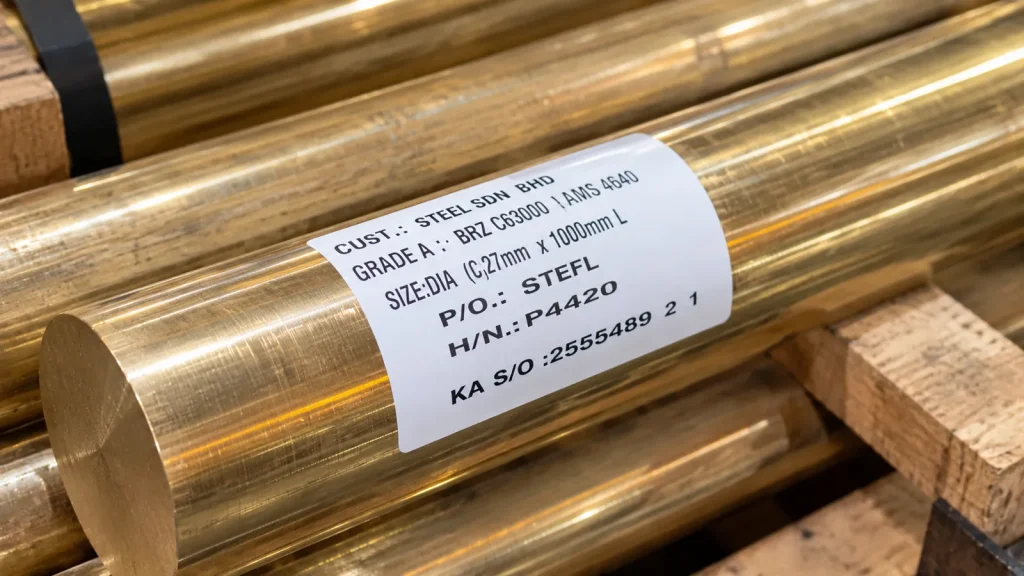
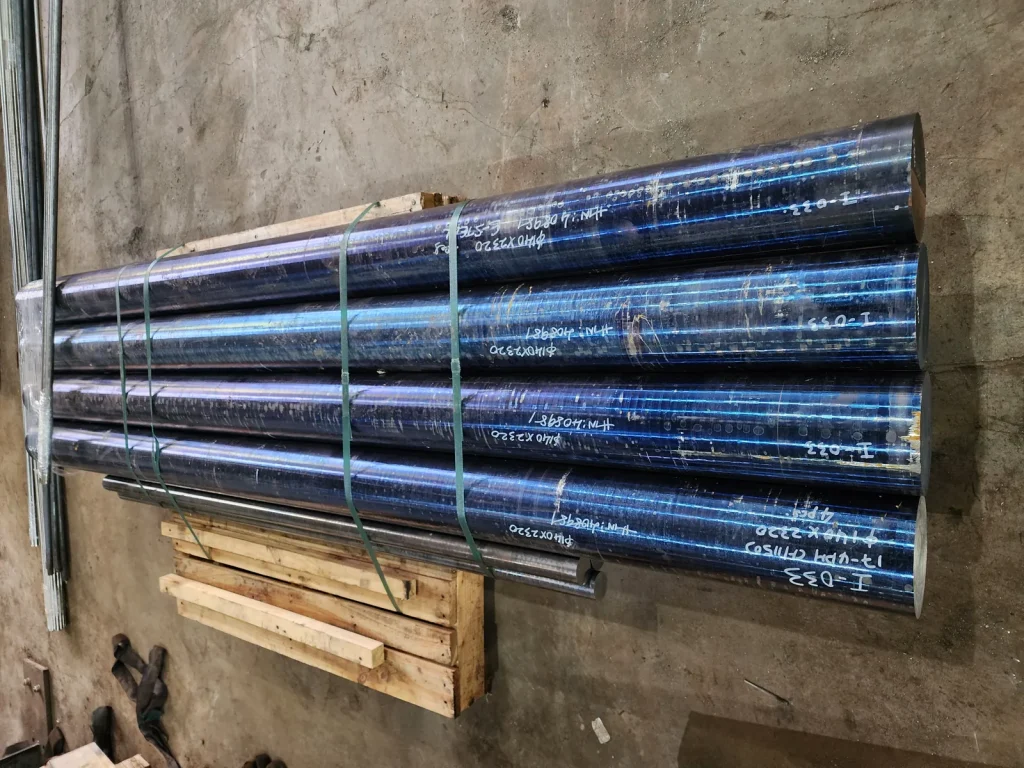
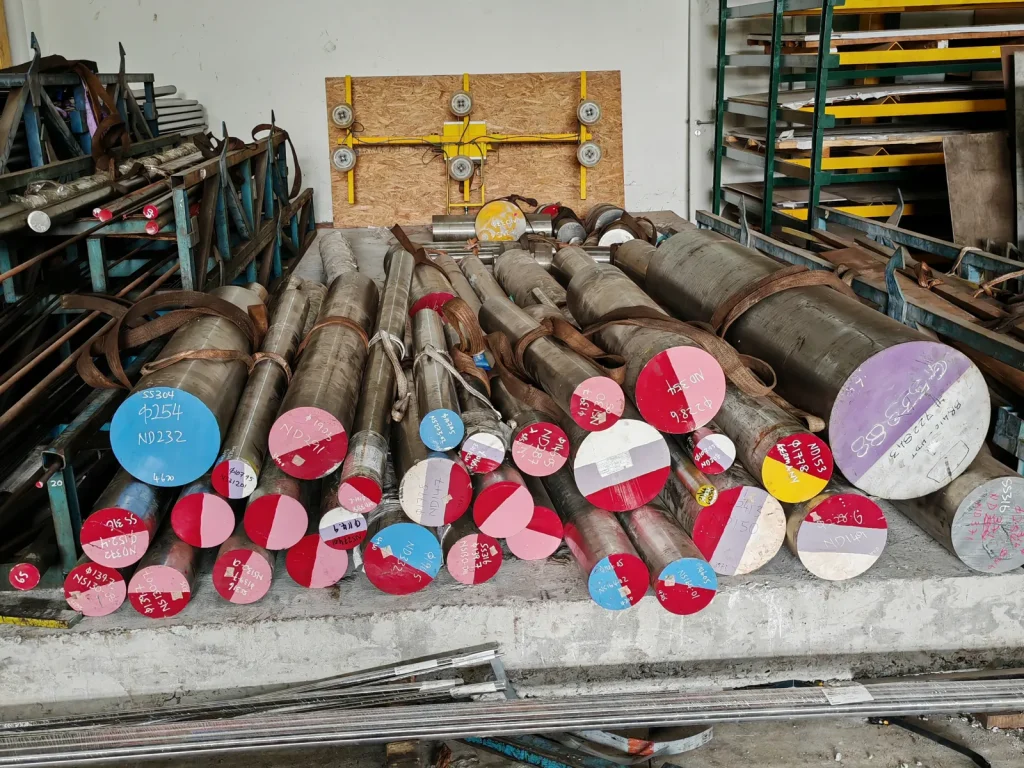
No MOQ, shipped globally from Malaysia. Send us the size and we will cut it.